Project on CMR Robot Arm

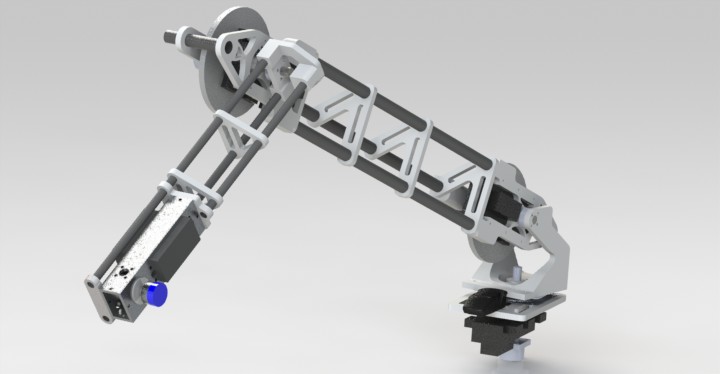
ur project was mainly designed for the Cornell Mars Rover project team (CMR), which will be using the robotic arm for competition to complete many different tasks in the deserts of Southern Utah.
We created the control systems for a robot arm that is able to use three different end attachments to perform a variety of specified actions, include pushing buttons, scooping up dirt or other items, picking things up with a hook, flicking switches, and taking voltage readings for solar panels. This robot arm uses the Arduino Mega2560 to take in commands from a user to determine which position to move to and what actions the arm needs to perform. It uses four different servo motors to control the four degrees of freedom over the wrist, elbow, and shoulder joints. Also, it controls three end attachments that are attached at the end of the arm: the hook, the scoop, and the control panel interface (CPI). Our controls are also able to open and close the scoop‟s lid servo and turn on and off the brush of the CPI, which has two probes attached that takes the voltage readings.

For Full Project Download here:
http://www.mediafire.com/view/?4msc6ondf00mhns

PID Controller on FPGA for Temperature Control


The objective of this project was to implement a digital PID controller on an FPGA for a control application. We designed a controller to track and maintain a set point temperature of a water tank with lowest possible overshoot while maintaining maximum possible rise time. Multiple controllers and heaters were used to efficiently control the temperature. We used MATLAB to design our controller and develop a model of our system from experimental data. The heaters were driven using a PWM signal from the FPGA that was amplified using BUZ 73 transistors.
The motivation behind using FPGA to implement a PID controller rather than microcontrollers or DSPs is because it provides a good balance between performance and cost. Using microcontrollers, although they may be cheaper do not provide enough processing power to effectively perform complex calculations in real-time. Digital signal processors can implement complex algorithms quickly but are expensive.

 Download the Project:
http://www.mediafire.com/view/?76wrpkb9s73l32l

Wind and Solar Power Systems

Wind and solar energy are pollution-free sources of abundant power. With renewable power generation expected to become more and more profitable with open access to transmission lines and rapid growth around the world, the design, operation, and control of alternative energy resources becomes an essential field of study. "Wind and Solar Power Systems" provides a comprehensive treatment of this rapidly growing segment of the power industry. It provides the fundamentals of wind and solar power generation, energy conversion and storage, and the operational aspects of power electronics and the quality of power. It covers in detail the design, operation, and control methods applicable to stand-alone as well as grid-connected power systems and discusses the present status of and the on-going research in renewable power around the world."Wind and Solar Power Systems" stands as the most modern, complete book available on renewable energy. Electrical, environmental and mechanical engineering professionals along with policy-makers evaluating the renewable energy potential of their regions will find in it the background and the details they need for decision making. It provides the fundamentals of wind and solar power generation. It shows the engineer how to design a key features of the power system. It details the operation and control of stand-alone and grid-connected systems. It presents methods for extracting maximum power from a given site and discusses power quality issues. It offers profitability charts for quick estimates of the market potential of sites. It discusses past and present industry trends and its future growth potential. It includes energy maps of several countries useful for assessing the energy potential of any site.

 Download:
http://www.mediafire.com/?ha2w62qp1zgaq5z

Project On Radar Simulation with Optical Sensor

This is a project  on radar simulation with optical sensor and in this system we are simulating the RADAR function with optical beam. We are providing an IR transmitter and receiver in place of RF transmitter and receiver. If any object, reflecting the IR rays back to receiver can be detected. This transmitter and receiver are placed on rotating antenna to detect angle of the object.

 Download Mediafire:
 http://www.mediafire.com/?wbb8ieu4iza7hke