Showing posts with label Robotic Project. Show all posts

Project On Security Robot Surveillance

As robotic technology continues to advance, robots are becoming capable of performing ever more complex tasks. Robotic workers never get tired, do not need to be paid, and can be made to perform even the most dangerous tasks without concern. The purpose of this project was to combine several existing technologies, wireless internet, neural networks, and hardware controllers, into a system that can perform the job of a night security guard.

Download Full Project:
Project On Security Robot Surveillance.pdf

Project on CMR Robot Arm

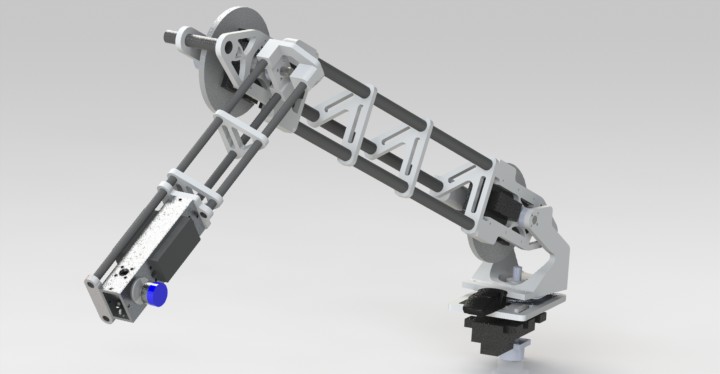
ur project was mainly designed for the Cornell Mars Rover project team (CMR), which will be using the robotic arm for competition to complete many different tasks in the deserts of Southern Utah.
We created the control systems for a robot arm that is able to use three different end attachments to perform a variety of specified actions, include pushing buttons, scooping up dirt or other items, picking things up with a hook, flicking switches, and taking voltage readings for solar panels. This robot arm uses the Arduino Mega2560 to take in commands from a user to determine which position to move to and what actions the arm needs to perform. It uses four different servo motors to control the four degrees of freedom over the wrist, elbow, and shoulder joints. Also, it controls three end attachments that are attached at the end of the arm: the hook, the scoop, and the control panel interface (CPI). Our controls are also able to open and close the scoop‟s lid servo and turn on and off the brush of the CPI, which has two probes attached that takes the voltage readings.

For Full Project Download here:
http://www.mediafire.com/view/?4msc6ondf00mhns

project on Bomb and Fire detection Robot

This is a good Robotics final year project on "bomb and fire detection robot" foe Electronics students which aims at designing and executing the bomb ,fire and obstacle detection. The IR sensor is a pair sensors has a receiver and a transmitter sensor. The transmitter sends the, and if the receiver senses any of the transmitted signal it indicates the presence of an obstacle. A micro-controller is used to control all operations. According to the motor operations the robot will operate as specified in program.

 http://www.mediafire.com/?hytueh7e704hr5p

Project On Evolving neural robot

The Project is to build a mobile robot with a developed neural network such that it evolves to avoid collisions into a circular vertical white wall while traveling at the fastest speed and straightest line possible without human intervention or external computers.

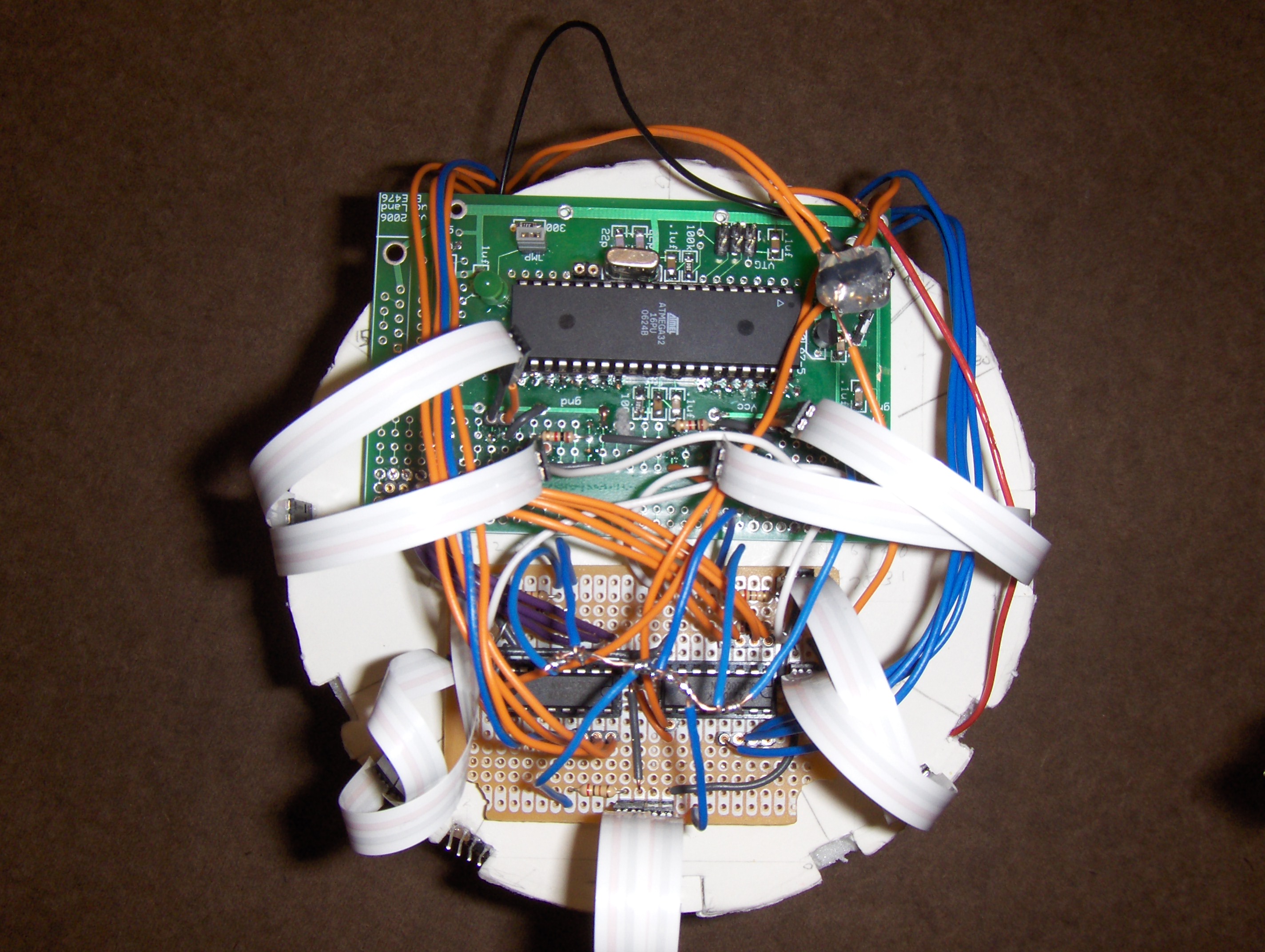
The completion of this project required extensive capacity and application on both hardware and software ends. In constructing the robot, we needed to build the custom prototype board, apply infrared sensors as neural inputs, implement stepper motors for robot motion, and provide a mobile power supply to the MCU. The purpose of these design factors is to allow the autonomous movement of the robot while minimizing the size of our robot, to accurately sense distance and collisions into the white wall of our arena, and to calculate the velocity precisely while providing sustainable torque to move our robot. On the software end, we needed to execute an evolutionary spiking neurons algorithm that interfaced with our hardware. The purpose of this was to integrate a spiking neural model with infrared sensors as inputs and motor speeds as outputs to determine robot velocity and direction. We also implemented the evolutionary model based on assessing random individuals of a randomly generated population through a fitness equation and improving the population by discarding the worst individual in the population with the worst fitness. The fitness equation measured by the velocity of the robot, the direction change, and the amount of activity from sensors. 
 Download Project:
http://www.mediafire.com/?o8u0kfu4386kr1c


Robotic Vacuum Cleaner Project

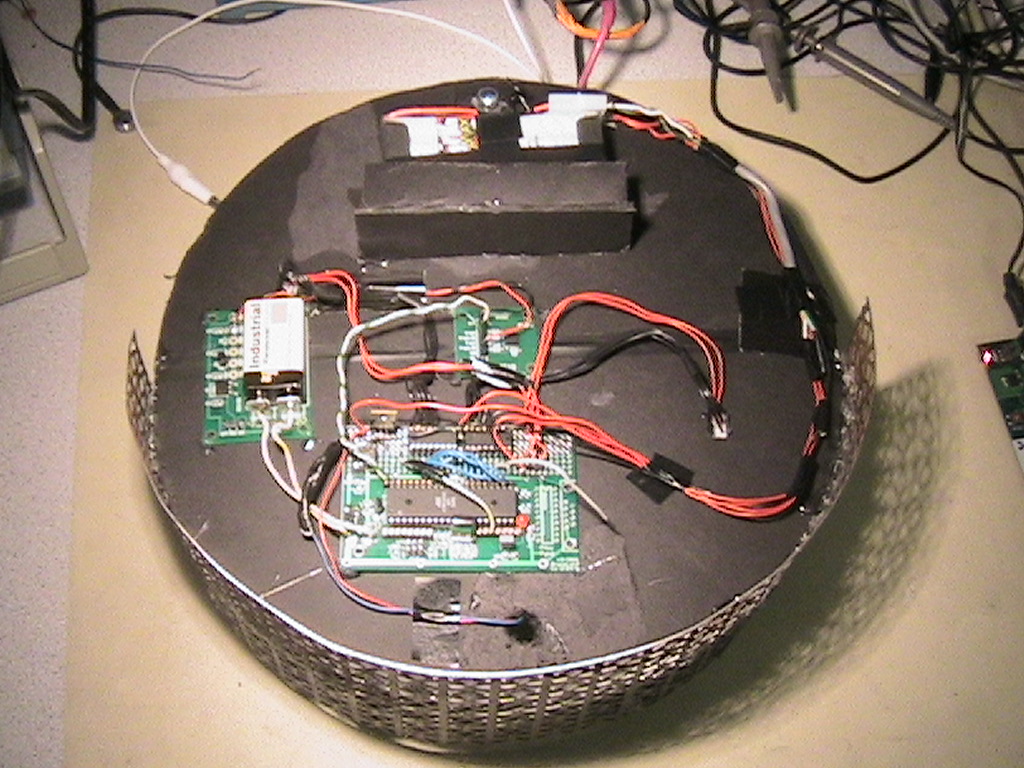
The robotic vacuum is mainly built from a circular piece of foam board.. The robotic vacuum uses a rotating brush underneath the unit to vacuum a carpet as it passes over it. Two stepper motors, aligned across the center axis of the robot, are used to accurately drive the robotic vacuum around a room. Because the body of the robot is circular and the steppers are placed along the center axis, the robot can spin in place in any direction. One free-spinning chair wheel is located at the rear of the robot to keep it balanced.

 Download Project:
http://www.mediafire.com/?u8ku388xc5jemt7

Project On autonomous Visually Steered Car

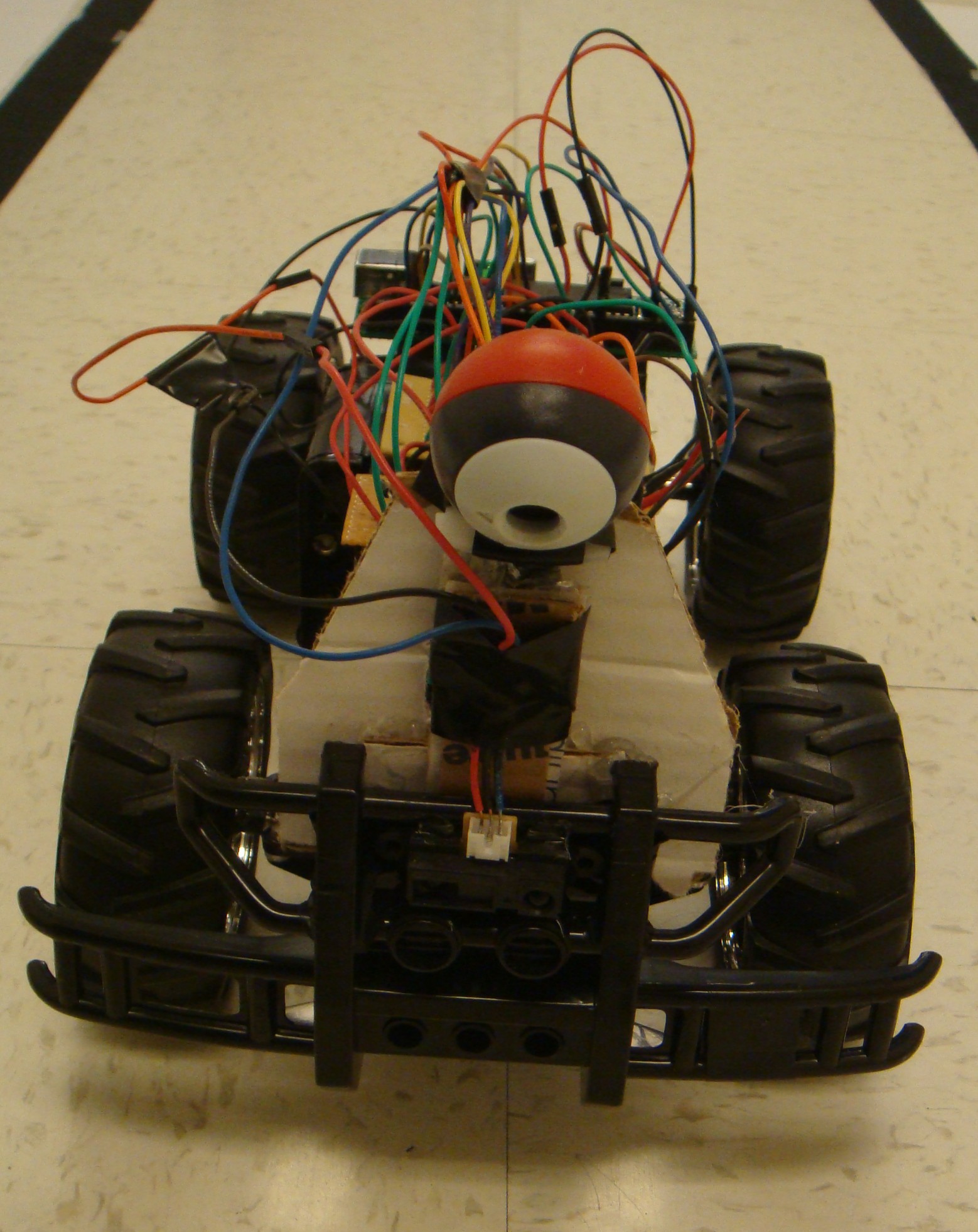
For our final project, we re-engineered a remote control car to autonomously navigate through a track by detecting lanes and centering itself between them as well as detect objects in front of it and avoid collision. The RC car detects lanes through image input from a low-resolution camera mounted at its front. Using an IR distance sensor, the car determines when to stop accelerating once a certain distance between a forward object has been breached. All computations based on sensor data are handled by an Atmel Mega644 MCU. Due to the nature of the input peripherals, especially the camera, this system is extremely time sensitive so that computations had to be optimized as much as possible in order for the car to be able to react and respond with proper movements in real time. In addition, given the limited computational capacity of this 8-bit MCU, our design made use of several computational efficiency strategies. 
 Download Project:
http://www.mediafire.com/?jc1jzclnsbragr2

Project on ROBOT ARM :

Our project is a twenty four and half inch aluminum frame robotic arm with four degrees of freedom. 
In our project we made the arm the second player in the classic game of Tic-Tac-Toe to demonstrate its programmable repeatable motion.  The arm consists of five servo motors, four to control the motion and one to control the end effecter (gripper). The arm moves tic-tac-toe pieces onto a board for its opponent and itself to give the user interactive control over the arm. 
 Download Project: 

Project On Robotic Car Traction Control

Robotic vehicles are becoming increasingly complex and often need high levels of movement control. Specifically, when the wheels of a vehicle begin to slip, it is optimal to adjust their speed so that the vehicle moves towards its intended direction. Applications include vehicles traveling over rough terrain, exploratory robots, and remote controlled cars. The purpose of our project is to design and implement a four wheel drive robot that monitors the rotational velocity of each wheel and limits the amount of slip when the vehicle is accelerating.

Download Project:
http://www.mediafire.com/?0dff62ngeu7kr73

Mini Project on Robotic Bug:

A free roaming robot does not have to very smart to function that suppose to be an intelligent Manner. The robot has only sense  an obstacle and avoid it. when that is repeated many times a path can always be found through its environment and the robot seems to be surviving on its own. The robot is a lot like to be a insect which contains two antennas that helps it to navigate around obstacle.
Download link:
Robotic Bug Project.Pdf

Project on Fire Fighting Robot

Trinity College hosts an annual Robot Fire-Fighting contest drawing participants from around the world. The contestants vary in age, skill level, and experience, ranging from middle school students, college students, professors and all other robot enthusiasts. The purpose of this contest is to simulate the real-world operation of an autonomous robot providing a fire protection function in a house. The situation being simulated is a robot inside a home responding to a smoke detector going off by searching the house for a fire and putting it out as fast as possible. The contest is used as an educational tool while simultaneously promoting advancements in the field of robotics. This robot will first be activated by a smoke alarm signal, which then will proceed throughout the mock household and search for a flame. Upon finding the flame, the robot will extinguish it by actuating a pressurized CO2 cartridge. Once the flame is out, the robot will return to its original starting position in the quickest amount of time possible. There is no weight restriction for this robot, but in order to maximize its speed and performance the robot will be light and small in size.

Download The Project Here:

Thesis on IMPLEMENTING A ROBUST 3-DIMENSIONAL EGOCENTRIC NAVIGATION SYSTEM

Robot Navigation is a large component of current robotics research. In this paper, a method to implement the “go-to-goal” aspect of navigation is discussed. Specifically, I will first discuss a method called Egocentric Navigation, which was developed at Vanderbilt University’s Center for Intelligent Systems. Then improvements toward making the system more accurate and efficient will be proposed. Finally, the experimental and simulation results of this new Egocentric Navigational system follow. In total, this paper will lay out a complete system for implementation on a robot which will accomplish navigation to goal in a landmark-based “egocentric” manner.

For Full Thesis Download:
ROBUST 3-DIMENSIONAL EGOCENTRIC NAVIGATION SYSTEM.Pdf

Using Robotic Hand Technology for the Rehabilitation of Recovering Stroke Patients with Loss of Hand Power

Stroke is the third leading cause of death in the United States. Nearly 700,000 people suffered from stroke last year and two thirds of them survived but were left with any number of disabilities, one such disability is upper extremity paraplegia. If the hand and arm doesn't have therapy immediately after stroke, it will lose it power and muscle control, resulting in a claw like appearance and loss of function. Activities of the patient daily living will be significantly effected. Current therapy on the affected limb in the hospital is expensive and difficult to manage due to the limited amount of resources compared to the number of patients. We introduce a pneumatic actuated wearable hand and forearm device in this thesis. It is designed according to the hand and arm kinematics. It can help the patients keep power on each finger and help maintain the coordination of different fingers to achieve daily living movements. It consists of forearm brace, rehabilitation glove and artificial muscles. The custom made artificial muscles also known as McKinney Artificial Muscles are used in antagonistic pairs to control the fingers flexing and extension. The rehabilitation device is small, lightweight, home-based, and has large force capabilities. It is also affordable to the patients due to the specially designed low-cost artificial muscles. The rehabilitation device was controlled by solenoid valves in conjunction with a Mitsubishi M32/83C 16-bit micro controller. Experiments on the pneumatic elbow brace have shown that it is capable of moving each finger from full extension to flexing, to perform actions like pinching and allows the coordinated movement of two fingers.

For Downloading Full Thesis click below:
Robotic Hand Technology.pdf

Project on Design of a Biped Robot with Efficient Motion Control

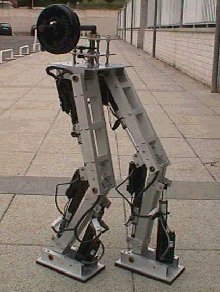
This Project involved construction, design, control and analysis of a Biped Robot. This robot uses the dynamic balancing for the Motion Control. The robot had two legs for walking. The robot was controlled using the 12 FUTABA S3003 servo motors which were controlled in the real time using the serial port programming of Servo motors with the Computer and the Microcontrollers PIC16F84 and PIC16F877.


For Full Project Download: 

Four Fingered Robotic Arm Project

This paper deals with the design, construction, analysis and control of a multi
figured humanoid robotic hand. It uses a very effective mechanism .The
mechanism has a revolute joints to provide different kind o motion to the links The mechanism consists of springs so that the weight of the system is balanced by these springs this reduces the torque required for the motion of the robot .Th mechanism used for the fabrication of the robot are mainly PERSPEX and WOOD because of their light weight.
The robot uses the Japanese futaba servo motors for motion of links. The
robot consists of four servo motors of the rating 6V and torque 3 kg-cm. The
robotic hand can be controlled by both the computer and the micro controller.
The robot is controlled in two ways Manual and Automatic. The robot
picks the object with the help of software program made in Visual Basic .Net.
The control software consists of a GUI (Graphical User Interface) designed in
Visual Basic .Net. The software provides the large flexibility in controlling the
robotic hand.


For Full Project Download:

Robotic Arm Project

The main objective of this project is to create the virtual representation of a robot’s working environment. This virtual space gives user the ability to test the physical system without ever having to set up the physical environment and also user can practice without having to be on site. Another benefit of using a virtual space is that we can create any representation needed for the user. To control the robot in the real world, as well as the virtual world, we use MATLAB/Simulink to numerically analyze the inverse dynamics of the system. This allows us to specify the robot’s position that we want and then calculate the joint angles that will move the robot to that desired position. The robot will be used to manipulate a set number of objects with known positions within the system, real world or virtual.


For Detail Download:

http://www.mediafire.com/?cd2iyzhnm3k

Robotic Project:

The Lego Mindstorms NXT has been in the market since 2006 and its potential for robotics application is increasing throughout the years. The Lego Mindstorms NXT educational kit consists of several types of sensors and motors, allowing the robot to be programmed to respond autonomously to different types of situations.

The traditional four-directional analog controller allows motion but is restricted by only the four
direction keys. The Nintendo Wii remote, which is otherwise known as the ‘Wiimote’, expands on the traditional controller by embedding an accelerometer and Infrared (IR) sensors. The accelerometer allows motion capture of the Wiimote along the XYZ axis as well as detecting the roll, yaw and pitch. Combined with the IR sensors, it allows very accurate motion tracking. With the motion tracking capability on top of the traditional controller capabilities, integrating the Wiimote to a robotics kit will allow the robot to be controlled with more finesse.

For Full Project Download here:
http://www.mediafire.com/?jn2nydudn5m