Showing posts with label Biomedical Thesis-Project. Show all posts

Project on Thermistor Respiratory Monitor


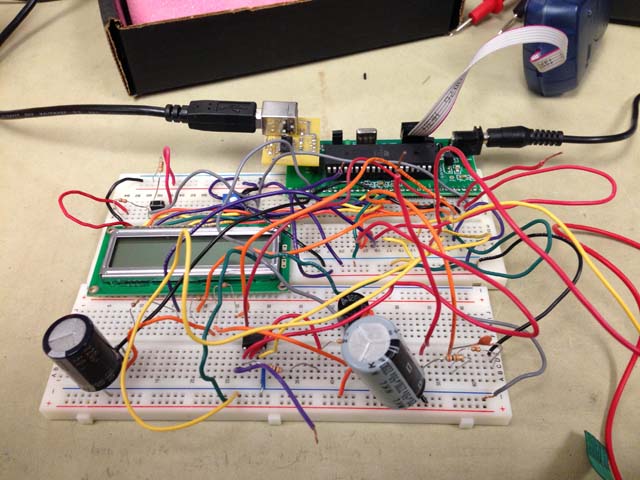
For our project, we wanted to create a solution to a real-world problem. Many biomedical devices, such as commercially available respiratory monitors, are designed for the developed world and require a stable power-supply to operate. We wanted to implement a solution that is adaptable to different environments.
Our device uses several concepts we learned this semester in College. We use analog-to-digital conversions to sample readings from both the thermistor and the battery, pulse-width modulation to generate a signal for the speaker, and timers to switch between tasks. Our implantation also includes various analog circuitry for voltage regulation and signal amplification. Developing a robust and accurate respiratory monitor served to be a challenging, yet rewarding experience.
Download The Project:

Thesis on Pulse Oximeter Calibrator

Pulse Oximeters are standard medical electronics devices used for continuous patient monitoring of arterial oxygen saturation (SpO2) and heart rate (HR). Initial calibration of pulse oximeters is conducted by inducing hypoxemia in healthy human volunteers to obtain blood oxygenation levels as low as 70% and comparing pulse oximeter measurements to that of a reference CO-oximeter.
It was the goal of this project to create a device which would increase the accuracy of the calibration process and potentially set the stage for the elimination of the need for human volunteers. Such a device would also significantly reduce cost and time for companies attempting to bring a new model of pulse oximeter to market. A device such as this, even if it is not used as a substitute for testing on humans, would allow the company the opportunity to test their device before making the expensive commitments involved with FDA testing.

Download Full Thesis:

Project on Pulse Oximeter

For patients at risk of respiratory failure, it is important to monitor the blood oxygen saturation of such individuals to ensure proper perfusion of blood in their system. Preferably this information should be received on a continuous basis. Both of these objectives can be reached via the non−invasive method of pulse oximetry. This is currently used in hospital/clinical settings, however uses wires which in effect bound an individual to an area. The purpose is to create a clinical diagnostic system which takes a few physiologically relevant signals and transmits them wirelessly to a base station.  This project specifically deals with the design of a wireless pulse oximeter for this system. By using the principle of differential light absorption and the assumption that the transmission of light through the arterial bed is influenced only by the relative concentrations of oxygenated and reduced hemoglobin and their  absorption coefficients at the two wavelengths, light intensity will decrease logarithmically according to Beer−Lambert’s law.The theory behind our device, hardware design and the experimental results of the system are presented.

For Full project Download:
Pulse Oximeter project.pdf

Project on Low-Cost Portable Potentiostat for Biosensing Applications

A potentiostat is an instrument used in chemical and biological tests that controls the voltage between two electrodes, working and reference, at a constant value. Chemical and biological tests are typically run in a three-electrode system, which includes the aforementioned working and reference electrode as well as a counter electrode. These systems are used to test the electrical activity of certain compounds or microbes, where the electrode acts as either the electron acceptor or electron donor. By monitoring the current and plotting the data against either time (chronoamperometry) or potential (voltammetry), information can be obtained as to the electrochemical activity of chemical compounds and/or microbes. In this project, we will present a design for this potentiostat using the ATMega644, an external digital-to-analog converter (DAC), and a series of operational amplifiers (op-amps). We will utilize the serial peripheral interface (SPI) to communicate between the microcontroller and DAC, the op-amps to process the signal from the DAC and apply a potential to the electrochemical cell, and the internal analog-to-digital converter (ADC) to record the current at the working electrode.
 Download Link:

Project on digital stethoscope

Our project is a digital stethoscope that displays your heartbeat on any television. It also calculates beats per
minute and alerts you if your rate falls out of a specified range.
At the highest level, the design of our project centers around an acquisition circuit, data processing in two
MCUs, and the output on a TV screen. The first part of the stethoscope is the acquisition unit, which consists of
an actual stethoscope mated with a microphone, and an amplifier circuit. The microphone captures the audible
signal from the body that is acoustically amplified by the stethoscope. After that, we bias and set the gain of the
signal using an operational amplifier so that the ADC on the MCU will be able to pick up the signal. The
analog data will be independently sampled by the two MCUs at a rate appropriate for display on the TV (CPU1) and a rate sufficient to capture the appropriate characteristics of the signal for beat detection (CPU2). CPU2, uses a moving threshold scheme to detect the actual heartbeats, and from that derive the heart rate. Then the signal is blasted to the TV, which also displays pertinent data, such as beats per minute. Additional information is displayed on the HyperTerm. If applicable, a buzzer will sound if your heart rate falls out of a specified range.

Download Links:
http://www.mediafire.com/?rraxo4zc4l0kk2w

Project on Analog Heart Rate Monitor(Cardiotach):

The CaRdiatach is an advanced solid state design useful for experimental or clinical monitoring of the Human heart rate. Experimentalist and clinical Technician can use it as response indicator of anxiety states or relaxation responses to such external stimuli as words, music, odors, visual displays etc. The pulse rate increase is usually quite rapid in response to anxiety-producing stimuli and can be a more accurate indicator of the body's state than verbal responses.

Download Link:
Analog heart reate monitor.Pdf

Total Project on Wind Turbine Construction

The purpose of this Post is to instruct how to build a wind turbine with rated power of 100 watts from cheap and easily available material. Model wind turbine was built in Helsinki University of Technology's engineering design workshop using mostly hand tools.
 Download Link:
 Wind Turbine Construction.Pdf

Project on Simple Digital Heart Rate Monitor

The aim of this project is to implement an ECG and Digital Heart Rate counter. The main challenges include amplifying the desired weak signal in the presence of noise from other muscles and electrical sources. A display of the heart rate will be obtained by measuring the time between signal peaks and then calculating the frequency of the peaks in units of beats per minute.
The device is most useful if it is portable. This requires a battery to be able to power all of the necessary components as well as the power output of the battery to be regulated.Our implementation of the heart monitor involves low cost amplifier and filter components coupled with a sophisticated microcontroller and LCD screen.
Results were successful for the amplifier filter stage of the implementation with an ECG successfully detected and recorded but variability of the voltage points complicated the calculation and display of the actual rate.
Download Link:
 Heart Rate Monitor.Pdf

Processing of the Phonocardiographic Signal: methods for the intelligent stethoscope

Phonocardiographic signals contain bioacoustic information reflecting the operation of the heart. Normally there are two heart sounds, and additional sounds indicate disease. If a third heart sound is present it could be a sign of heart failure whereas a murmur indicates defective valves or an orifice in the septal wall. The primary aim of this thesis is to use signal processing tools to improve the diagnostic value of this information. More specifically, three different methods have been developed.


For Full Download Click the link Below:
Phonocardiographic Signal.pdf

Thesis/Project on Segmentation of the Brain from MR Images

KTH, Division of Neuronic Engineering, have a finite element model of the head. However, this model does not contain detailed modeling of the brain. This thesis project consists of finding a method to extract brain tissues from T1-weighted MR images of the head. The method should be automatic to be suitable for patient individual modeling. A summary of the most common segmentation methods is presented and one of the methods is implemented. The implemented method is based on the assumption that the probability density function (pdf) of an MR image can be described by parametric models…

 For Full Download :
Segmentation of MR Images.Pdf

Using Robotic Hand Technology for the Rehabilitation of Recovering Stroke Patients with Loss of Hand Power

Stroke is the third leading cause of death in the United States. Nearly 700,000 people suffered from stroke last year and two thirds of them survived but were left with any number of disabilities, one such disability is upper extremity paraplegia. If the hand and arm doesn't have therapy immediately after stroke, it will lose it power and muscle control, resulting in a claw like appearance and loss of function. Activities of the patient daily living will be significantly effected. Current therapy on the affected limb in the hospital is expensive and difficult to manage due to the limited amount of resources compared to the number of patients. We introduce a pneumatic actuated wearable hand and forearm device in this thesis. It is designed according to the hand and arm kinematics. It can help the patients keep power on each finger and help maintain the coordination of different fingers to achieve daily living movements. It consists of forearm brace, rehabilitation glove and artificial muscles. The custom made artificial muscles also known as McKinney Artificial Muscles are used in antagonistic pairs to control the fingers flexing and extension. The rehabilitation device is small, lightweight, home-based, and has large force capabilities. It is also affordable to the patients due to the specially designed low-cost artificial muscles. The rehabilitation device was controlled by solenoid valves in conjunction with a Mitsubishi M32/83C 16-bit micro controller. Experiments on the pneumatic elbow brace have shown that it is capable of moving each finger from full extension to flexing, to perform actions like pinching and allows the coordinated movement of two fingers.

For Downloading Full Thesis click below:
Robotic Hand Technology.pdf

Project On Simple Inexpensive X-Ray Machine

X-ray equipment is costly. Even tubes of relatively low power are priced at $100 and up. Many other commercial X-ray parts are also expensive and difficult to procure. The apparatus supplying high voltage to conventional tubes, while no more complex than the power supply of a husky radio transmitter, calls for special rectifying devices, transformers and other components which are not regularly stocked by dealers in electrical supplies.
Moreover, X-rays have earned a bad reputation as playthings. No distinction can be drawn between the danger of exposure to a high-powered X-ray machine and the fallout of an H-bomb. It is a danger that extends not only to the experimenter but to his potential progeny. Human evolution is the result of mutations caused by, among other agents, cosmic rays and the radiations of radioactive elements in the earth's crust. Any radiation added by man alters the rate of mutation, and is rightly a cause of deep concern.

Simons Project has solved the problem of equipment cost. Protection against exposure to the rays is not difficult to arrange. With these two considerations out of the way, X-rays open a range of experiments equaled by few other phenomena of physics. In addition to providing a source of X-rays for radiographs, a generator of X-rays in combination with accessories enables you to measure the charge of the electron, to study the structure of crystals, to observe the wave-particle duality of matter and radiation, and to probe other microcosmic corners.
 
For Detail download:
Inexpensive X-ray Machine.pdf

Project/Thesis on Digital Blood Pressure Meter:

Though this is not full Thesis but it definitely  describes a Digital Blood Pressure Meter concept which uses an integrated pressure sensor, analog signal-conditioning circuitry, microcontroller hardware/software and a liquid crystal display. The sensing system reads the cuff pressure (CP) and extracts the pulses for analysis and determination of systolic and diastolic pressure. This design uses a 50 kPa integrated pressure sensor (Freescale Semiconductor, Inc.P/N: MPXV5050GP) yielding a pressure range of 0 mm Hg to 300 mm Hg.


Download The Project from Here:
Digital Blood Pressure Meter.pdf

Project/Thesis on Wireless ECG machine:

The overall objective of this project is to design and implement a prototype ECG system which replaces wired connections between sensor points and a central node with wireless links. Successful implementation of the final system would be of benefit to all involved in the use of electrocardiography as access to, and movement of, the patient would not be impeded by the physical constraints imposed by the cables. Most aspects of the design would also be portable to other sensor applications, making the work relevant to a vast range of systems where movement of sensors is desirable and constrained by hard-wired links. The design and implementation of the wireless link and ECG sensor electronics to produce an ECG signal form the basis of the Wireless ECG Monitors. The Wireless Sensor Protocol (WSP) was hence produced to handle the wireless link. Analogue electronics are used to obtain the signal and to filter noise, while PC based software is used to display the results. The WSP for the ECG system consists of two Slave nodes and one Master node. The Slave node prototype consists of an ECG sensor (with associated electronics), PIC microcontroller and Nordic's nRF401 UHF transceiver, as 'patches' ordinarily placed on the patient. Altera.s Nios Softcore processor (16 bit design) with Nordic's nRF401 UHF transceiver forms the Master (base) node where data is collected and an ECG signal is calculated for displaying to the medical staff.


Download the whole Project from here:

TRANSMITTING BIOLOGICAL WAVEFORMS USING A CELLULAR PHONE

There exists a need to remotely monitor fully mobile patients in their natural environments. Monitoring a patient’s biological waveforms can track a patient’s vital signs or facilitate the diagnosis of a disease, which could then be treated to help prolong and/or improve the subject’s life. If a patient must be monitored without the delay associated with delivering data stored on a recording device, biotelemetry is necessary. Biotelemetry entails transmitting biological waveforms to a remote site for recording, processing and analysis. Due to the limitations of the currently popular methods of biotelemetry, this thesis proposes the use of the increasingly prevalent cellular phone system. An adaptor design is developed to facilitate biotelemetry utilizing the most common features of a cell phone, barring the need for cell phone modification, as required for affordability. As cell phones notoriously confound sensitive medical equipment, especially patient-connected devices, their use is often distanced from sensitive equipment. However, the desire to use cell phones to transmit biological waveforms requires their joint-proximity to patient-connected devices.The adaptor must amplify the waveforms while rejecting cell phone interference to achieve an adequate signal-to-noise ratio. As the frequency range of most biological data does not conform to the passband of the phone system, the adapter must modulate the biological data. To limit the adapter’s size and weight, this design exploits the cell phone’s battery power. Methods are also introduced to receive and reconstruct high-fidelity representations of the original biological waveform.


For Detail Download the Following Link:
http://www.mediafire.com/?o4tynkjnnoz