Showing posts with label Interfacing based projects. Show all posts

Project On Ultrasound Gesture Detection

In this project, ultrasound around 24kHz was used to detect movement near an object. Waving a hand or other solid object near the source of the ultrasound (speaker) causes a shift in the frequency of the sound, which is then detected by a microphone. We detected characteristic shifts in frequency to determine whether motion was towards (push) or away from (pull) the microphone. Two modes of visual indication were used to display the results of the motion detection: blinking LEDs and a computer display. With the blinking LEDs, a different color LED would light up according to the direction of motion detected. In the computer animation, the waveform would be displayed on screen along with markings of which parts are pulls and pushes. Sections of the waveform that represent different motions would be marked as push or pull.

 Download Link:

Project On Sonar SensCap

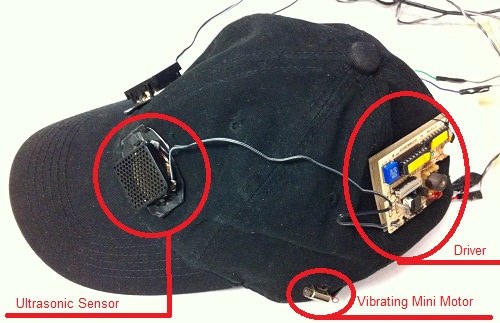
This device is  to be worn on the head and around the hip to aid the visually impaired maneuver around obstacles. It provides information about obstacles near and around the head. When used with a cane, the user will have a complete sense of the topology of surrounding environment. This  device decreases the dependence of the visually impaired on others and increases their safety.
The device uses two ultrasonic sensors and a microcontroller to determine the proximity of the user to obstacles. The user has the option to choose between two modes of user feedback-headphones or vibrating motors. Both provide information about the location of and distance to an obstacle. The harder the motors vibrate or the louder the sound is, the closer the user is to an obstacle.

 Download Project:
http://www.mediafire.com/?f7wbnbcfv3tcb3c

Project on Ultrasonic Haptic Vision System

The ultrasonic haptic vision system enables a person to navigate hallways and around large objects without sight, through the use of an ultrasonic rangefinder that haptically interfaces with the user via tiny vibrating motors mounted on the user’s head. The idea behind this project was to construct a sixth sensory system that interacts with the body in an intuitive and user friendly fashion and enables the user to navigate without vision. We also implemented RF transmission in order to provide feedback to a program running on the computer to keep track of the sensory data obtained from the mobile user mounted sensor system. This enabled the person sitting at the computer to observe all the distances between the surrounding obstacles and the user wearing the hat. The rangefinder rotated on a motor atop the hardhat in order to take the sensory data at discrete points around the user. The hat and required hardware is all battery powered so that it is totally mobile and can be used as intended, so that movement is not restricted by the length of wires.

Download Link:

Project on Phase Contrast MRI Measurements:

Phase-contrast magnetic resonance imaging (PC-MRI) is a powerful tool for measuring blood flow and has a wide range of cardiovascular applications. Simulation of PC-MRI from numerical flow data would be useful for addressing the data quality of PC-MRI measurements and to study and understand different artifacts. It would also make it possible to optimize imaging parameters prior to the PC-MRI measurements and to evaluate different methods for measuring wall shear stress.Based on previous studies a PC-MRI simulation tool was developed. An Eulerian-Lagrangian approach was used to solve the problem. Computational fluid dynamics (CFD) data calculated on a fix structured mesh (Eulerian point of view) were used as input. From the CFD data spin particle trajectories were computed. The magnetization of the spin particle is then evaluated as the particle travels along its trajectory (Lagrangian point of view).The simulated PC-MRI data were evaluated by comparison with PC-MRI measurements on an in vitro phantom. Results indicate that the PC-MRI simulation tool functions well. However, further development is required to include some of the artifacts. Decreasing the computation time will make more accurate and powerful simulations possible. Several suggestions for improvements are presented in this report.


For Full Project Download:
MRI measurments.Pdf

Project on Digital thermometer:

This project is a 3-digit digital thermometer easy to build for beginner or hobbyits.PIC16F628 used to read digital value of temperature from a DS1820 sensor.All 7-segments drived by power logic 8-bit shift register TPIC6B595 with open collector output. For the 7-segment need 12V volt to drive because it have 3 LED per one segment.All segment no need to scan display. Source code programming with CCS C Compiler availible.

Downlad The full project from here:

Design and Implementation of computer Interfacing based Thermometer


The Project  is classified into following four sections-
1. Sensing section
2. Measuring section
3. Conditioning or amplification section
4. Interfacing or data acquisition section.
5. Display section.
Sensing and measuring section sense temperature and convert it into electrical quantity as voltage. Conditioning or amplification section amplifies the measuring section output, which is the input of data acquisition section. For conditioning we use non inverting amplifier. At data acquisition section we use analog to digital converter(ADC) for digital output and a multiplexer for converting ADC output from parallel to serial. The multiplexer output is sensed by a parallel port of personal computer by Matlab. Then the digital value is converted to decimal. From temperature versus voltage equation we get measured temperature.

Download The complete project from here:
Temperature measure by PC.pdf