Showing posts with label Motor Related Project/Thesis. Show all posts

Autonomous Underwater Vehicle Design Project

Autonomous vehicles are increasingly investigated for use in oceanographic studies, underwater surveillance, and search operations. Research currently being done in the area of autonomous underwater craft is often hindered by expense. This project seeks to complete the construction, optimization, and control software development of an inexpensive underwater vehicle. During the course of the project all of the vehicle’s mechanical and electrical subsystems were completed. Propeller-driven primary thrusters using a magnetically coupled drive system were optimized and manufactured. A battery powered electrical subsystem was also designed and installed on the vehicle. A simulation of the vehicle’s control algorithm was developed in MATLAB and several full vehicle tests were conducted.
Download Project:Autonomous Underwater Vehicle Design Project.pdf

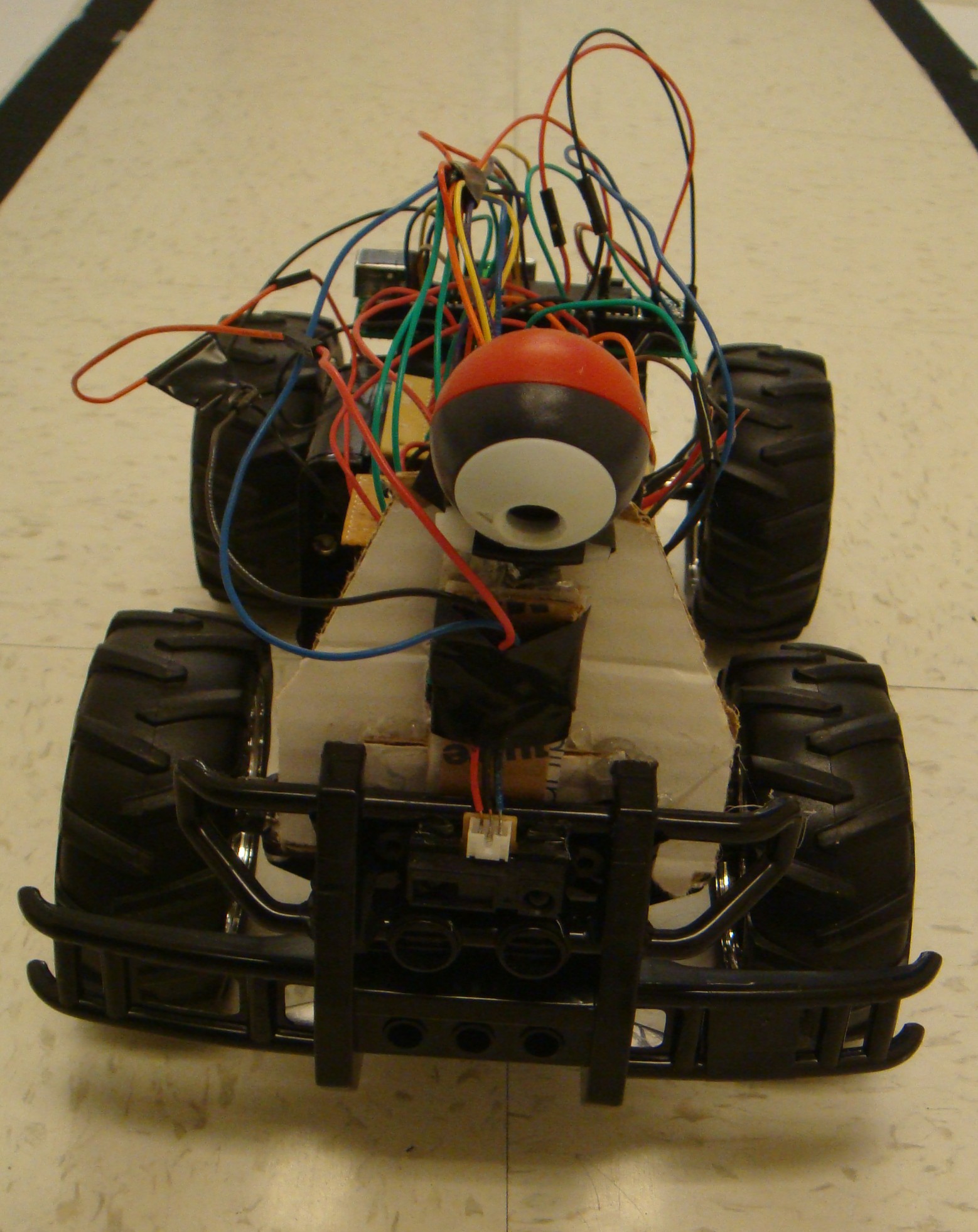
Project On autonomous Visually Steered Car

For our final project, we re-engineered a remote control car to autonomously navigate through a track by detecting lanes and centering itself between them as well as detect objects in front of it and avoid collision. The RC car detects lanes through image input from a low-resolution camera mounted at its front. Using an IR distance sensor, the car determines when to stop accelerating once a certain distance between a forward object has been breached. All computations based on sensor data are handled by an Atmel Mega644 MCU. Due to the nature of the input peripherals, especially the camera, this system is extremely time sensitive so that computations had to be optimized as much as possible in order for the car to be able to react and respond with proper movements in real time. In addition, given the limited computational capacity of this 8-bit MCU, our design made use of several computational efficiency strategies. 
 Download Project:
http://www.mediafire.com/?jc1jzclnsbragr2

Analysis of Frequency Response of Synchronous Machines Using the Magnitude Data

Over the past two decades, frequency response tests have become widely accepted as an alternative for determination of synchronous machine parameters. As a machine equivalent circuits move towards the high order models, designers need to analysis the performance and characteristics of the frequency response tests data. A major benefit of frequency response tests allows a more accurate modelling for the direct and quadrature axis. The normal approach is to use numerical curve-fitting techniques to match the measured data with the initial estimates time constants.
Due to the difficulty of estimating the higher order models, this thesis project is undertaken to design and implement the time constant extraction using an analytical method. This task can be divided into two steps: Firstly, the research into current methods used for determining the both axes equivalent circuit parameters. Secondly, development of the mathematical model was to be performed using theoretical analysis and then implement the design into the simulation program using the MATLAB software. The design program will only focus on the magnitude data of the step response. This program did not require an intimate understanding of the system order to be develop but utilized only the step response of the system.

Download from here:

Project On Automatic Railway Gate Control & Track Switching

Present project is designed using 8051 microcontroller to avoid railway accidents happening at unattended railway gates, if implemented in spirit. This project utilizes two powerful IR transmitters and two receivers; one pair of transmitter and receiver is fixed at up side (from where the train comes) at a level higher than a
human being in exact alignment and similarly the other pair is fixed at down side of the train direction.


Sensor activation time is so adjusted by calculating the time taken at a certain speed to cross at least one compartment of standard minimum size of the Indian railway. We have considered 5 seconds for this project. Sensors are fixed at 1km on both sides of the gate. We call the sensor along the train direction as ‘foreside sensor’ and the other as ‘aft side sensor’. When foreside receiver gets activated, the gate motor is turned on in one direction and the gate is closed and stays closed until the train crosses the gate and reaches aft side sensors. When aft side receiver gets activated motor turns in opposite direction and gate opens and motor stops. Buzzer will immediately sound at the fore side receiver activation and gate will close after 5 seconds, so giving time to drivers to clear gate area in order to avoid trapping between the gates and stop sound after the train has crossed.

Download the Project here:


Thesis on A High Performance DSP Based System Architecture for Motor Drive Control


 This paper presents a high speed digital signal processor (DSP) based system architecture for motor drive control. The system achieves fast speed performance by using the 50 MHz TMS320C25 DSP and specialized digital hardware to perform data acquisition and output control tasks usually performed in software. The peripheral hardware has been designed for easy interface to many types of motor drive systems, to make the system generally applicable in the motion control field. The specifications, systematic design, and realization of this general purpose controller are described. Software to support the features of the system is discussed. Experimental results using the proposed system to control a switched reluctance motor drive, both in torque mode and four quadrant speed operation, verify the speed performance of the DSP based system.

For Full Thesis Download:
MOTOR DRIVE CONTROL.Pdf